The map isn't hard to read. The challenge is knowing what you're looking at. I opened Mapdy, zoomed in on Da Nang, and immediately saw three things that most restaurant owners are overlooking.
Looking from the top: the chain has closed, but the game isn't over yet.
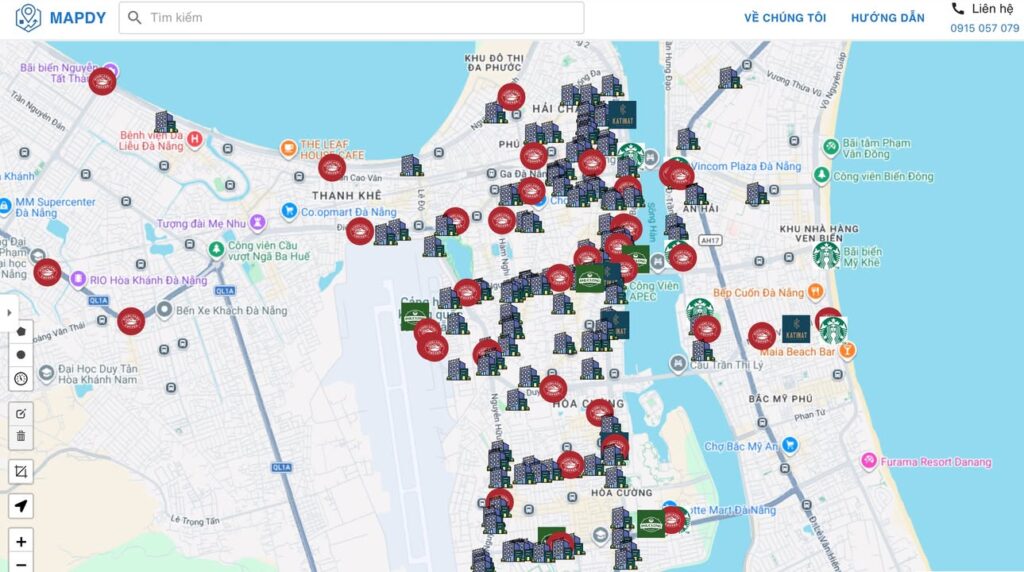
The two images below are real data from Mapdy—a location intelligence mapping platform that Binh and I are building—taking pictures of the Hai Chau, Thanh Khe, and part of Son Tra areas in Da Nang.
Look at the first picture: Highlands Coffee, Phuc Long, Katinat, and Starbucks are densely packed along the central axis. Just the corridor from Da Nang Train Station down to Tran Thi Ly Bridge has a very high density of chain coffee shops. If you plan to open a coffee shop with a "good location, basic menu, and normal operation" in this area, you're competing with brands that have spent tens of billions of dong on marketing, standardized operations, and the capacity to withstand losses for many years.
WinMart stores are appearing almost everywhere, from the city center to the outskirts. Alongside them, Pharmacity, An Khang, and Long Châu are competing for every street corner. Jollibee and KFC have also established a presence. This is a clear sign: modern retail is "filling" Da Nang at a pace unimaginable five years ago.
The question isn't "Is there still room in the market?" but rather "Where is the real space, and for whom is that space available?"“
What are the market data saying?
According to the Vietnam F&B Market Report 2025 (iPOS.vn (& Nestlé Professional), the entire industry currently has approximately 329,500 stores, with total revenue reaching ~726,500 billion VND, an increase of 5.51% compared to 2024. This sounds positive. But hidden behind those numbers is a harsher reality: in just the first half of 2025, 50,000 F&B stores withdrew from the market due to cost pressures. (Dân TríiPOS)
Industry revenue is increasing, but the number of businesses closing is also rising. This means the market share is becoming more concentrated in the hands of those who know how to operate effectively.
As many as 69,381 F&B businesses are facing pressure from rising raw material prices. In many cases, revenue is increasing, but profits are not improving proportionally. To put it bluntly: many establishments are selling more but keeping less profit. (VnBusiness)
By 2026, the Vietnamese F&B market is projected to reach 333,600 outlets with expected revenue of 760 trillion VND. However, this is considered a transitional phase for the industry, shifting from rapid growth to substantial development, where trendy restaurant openings give way to well-structured operating models. Da Nang is no exception to this trend. In fact, with its unique tourism characteristics, young population, and rapid urbanization, the competitive pressure here is even more intense than the national average.
Three things I noticed clearly when looking at the map of Da Nang.
1. A good location is no longer an inherent advantage.
The Võ Nguyên Giáp, Nguyễn Văn Linh, and Điện Biên Phủ thoroughfares—the "golden" roads of Da Nang—are now saturated in many segments. Opening a business here without a clear concept, without a reason for customers to return, and relying solely on a prime location, will result in exorbitant rental costs eroding all profits.
Meanwhile, developing areas like Lien Chieu, Ngu Hanh Son, or the outskirts of Hoa Xuan are lacking F&B models that are suitable for the local communities. This is a real gap, not just a gap on a map, but a gap in needs that are not being properly served.
2. Retail chains are retraining consumer behavior.
WinMart's widespread presence means that people in Da Nang are becoming accustomed to convenient shopping standards, consistent experiences, and transparent pricing. This creates invisible pressure on smaller retailers: if they can't create a reason for customers to choose them over the chain, they will lose on their home turf.
But precisely because chains are mass-producing the experience, establishments with unique personalities and genuine community connections have an even greater opportunity to stand out.
3. Tourists ≠ loyal customers
Da Nang attracts a large number of tourists, but that's a double-edged sword. Many business owners open establishments targeting transient visitors, forgetting that the off-season can last for months. The businesses that survive in Da Nang over time have a solid base of local customers to sustain revenue when tourists are absent.
Retaining customers—not just attracting new ones—is a matter of survival.
Minh Phan – Choosing the right location
Did you find this article helpful?
Sign up to receive new articles every week on store layout and retail development.