(Part 2 in the series "Reading the Highlands Coffee Map")
When I asked several F&B brand owners planning to open a chain what they could learn from Highlands Coffee, the most common answer was: "They chose beautiful locations, prime spots." That answer isn't wrong, but it only describes the result, not the mindset.
After more than 12 years in store development and observing hundreds of location selection decisions by large and small chains in Vietnam, I've realized that Highlands Coffee isn't simply about "choosing a good location." They follow a completely different logic, and once you understand that logic, you'll view Highlands locations on the Mapdy map in a completely different light.
Before getting into the content, I want to clarify my approach to this article so you can verify it for yourself, not just read and believe it.
I use three main sources: store location data from Mapdy.vn To observe the geographical distribution pattern; to compare the quarterly financial reports of Jollibee Food Corporation (the parent company holding shares in Highlands) to assess business performance across different expansion phases; and to observe the situation on-site at store clusters in Ho Chi Minh City, Hanoi, and Da Nang. These three sources complement each other: maps show the pattern, financial reports show the results, and on-site observations reveal the reasons.
Three store models and the strategic implications of each type.
What few people notice is that Highlands Coffee doesn't just have one type of store. Looking closely at their system, I see at least three models operating in parallel, each serving a different strategic objective.
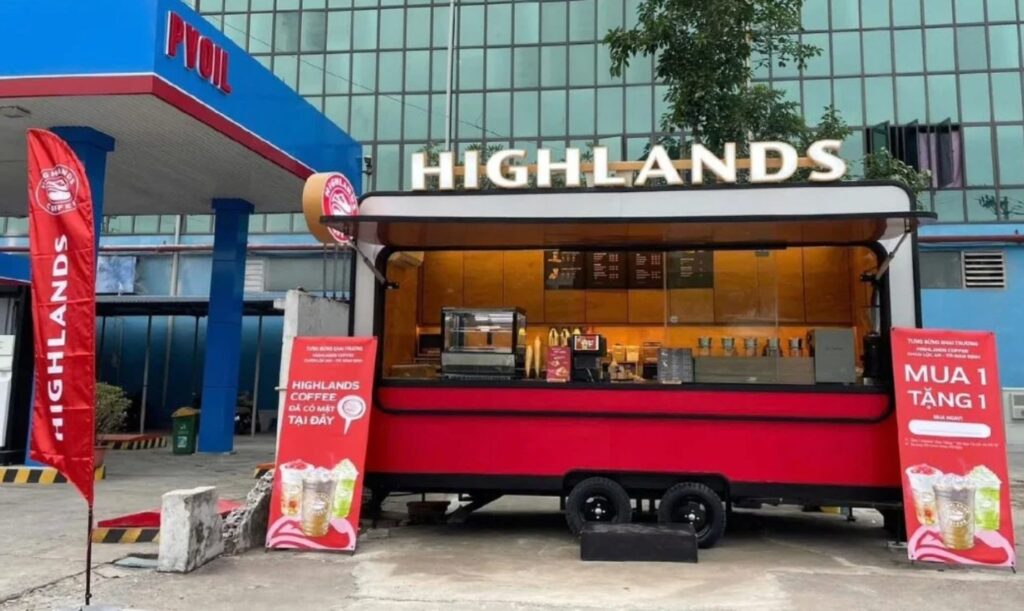
 Kiosk model (5-10m²), usually located at gas stations or transfer points.
This is the latest model and, in my assessment, is most likely still in the testing and refinement phase. The logic of this model is clear: serving on-the-go customers, those who don't need to sit down but just want a cup of coffee on the go. A space of 5–10 m² means virtually zero rental costs compared to a standard model, and revenue per square meter, if operated well, will be extremely high.
However, the kiosk at the gas station raises some unanswered questions.
Firstly, this is a completely different customer group from those who sit for two hours in a standard cafe. Will the Highlands brand be diluted by appearing in this format?
Secondly, kiosk orders are primarily grab-and-go, meaning there's no upselling or loyalty loop like when customers are seated in the shop.
Third, operating a kiosk with a small team requires a very high level of process standardization, something that even large global chains take years to get right.
I'm not saying this model will fail. I'm saying this is a problem without a complete solution, and Highlands is using real-world scenarios to find one. That's how an organization conducts controlled testing before scaling up.
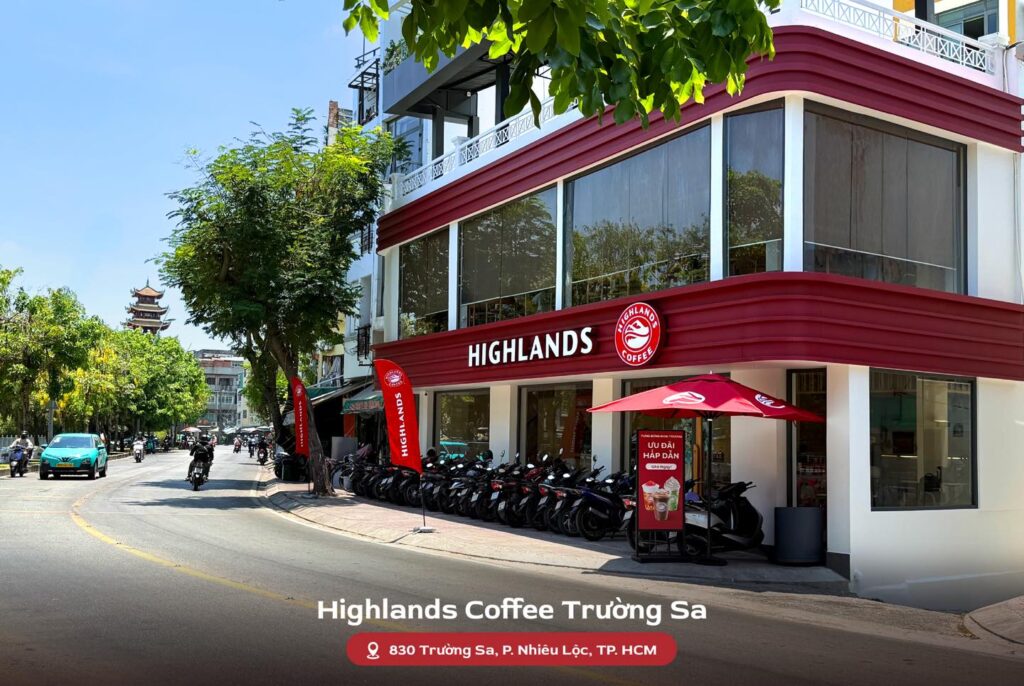
Standard model (100-150m²), the backbone of the entire system.
This model accounts for the majority of Highlands' current 1,011 stores. When I look at the Mapdy map and zoom in on any Highlands cluster in Hanoi or Ho Chi Minh City, most of the locations I see fall into this category.
According to Highlands' franchise information, the minimum area for a standard store is 150–250m², preferably a corner location at a T-junction, ground floor, and with a wide storefront. However, interestingly, when I visited the site and compared this with Mapdy data, I found many Highlands locations operating effectively with actual areas of only around 100–200m², especially on older commercial streets in the centers of Ho Chi Minh City and Hanoi, where large, reasonably priced spaces are almost non-existent.
This model optimizes three things simultaneously: enough space to create a true "coffee shop" atmosphere, controllable rental costs, and sufficient service capacity to achieve break-even quickly. This is also why the 8% increase in same-store sales in Q1/2026 is significant; it shows that these benchmarks are performing better over time, not just at the time of opening.
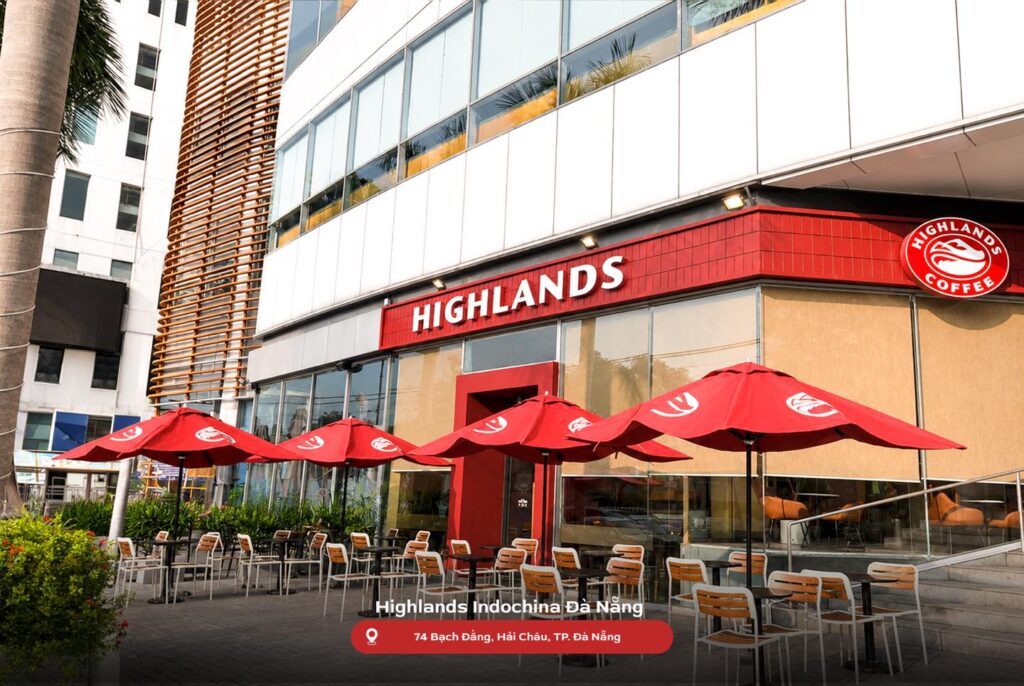
The flagship model, spanning over 200m², is more than just a coffee shop.
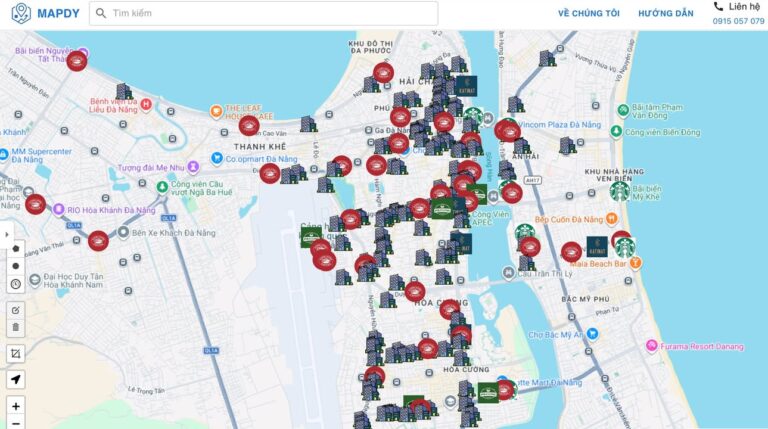
This group is small in number but crucial to brand strategy. These are Highlands stores that, upon entering, immediately make you understand why they are called "flagship"—spacious, iconic locations, often situated in high-value landmark areas. A prime example is Highlands Coffee at 74 Bach Dang, Da Nang, the brand's first location in the city, opened in 2009, with a direct view of the Han River. Or locations on the ground floor of Grade A office buildings in the heart of Ho Chi Minh City and Hanoi.
These locations aren't optimal in terms of revenue per square meter due to high rental costs, large areas, and more staff. But they do something that standard locations can't: they are living billboards. Every time a customer sees Highlands in a prime, iconic location, they associate the brand with quality and reputation, even if they don't make a purchase. This effect spreads throughout the entire system, including the regular standard locations.
So what logic does Highlands follow in choosing its locations?
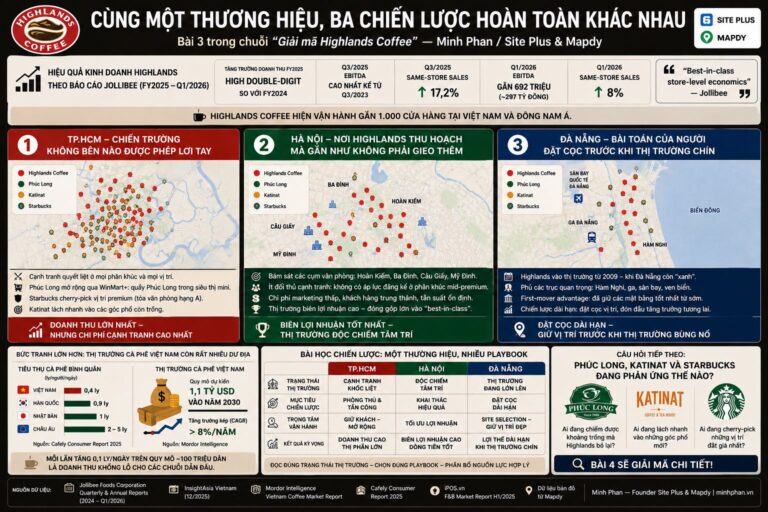
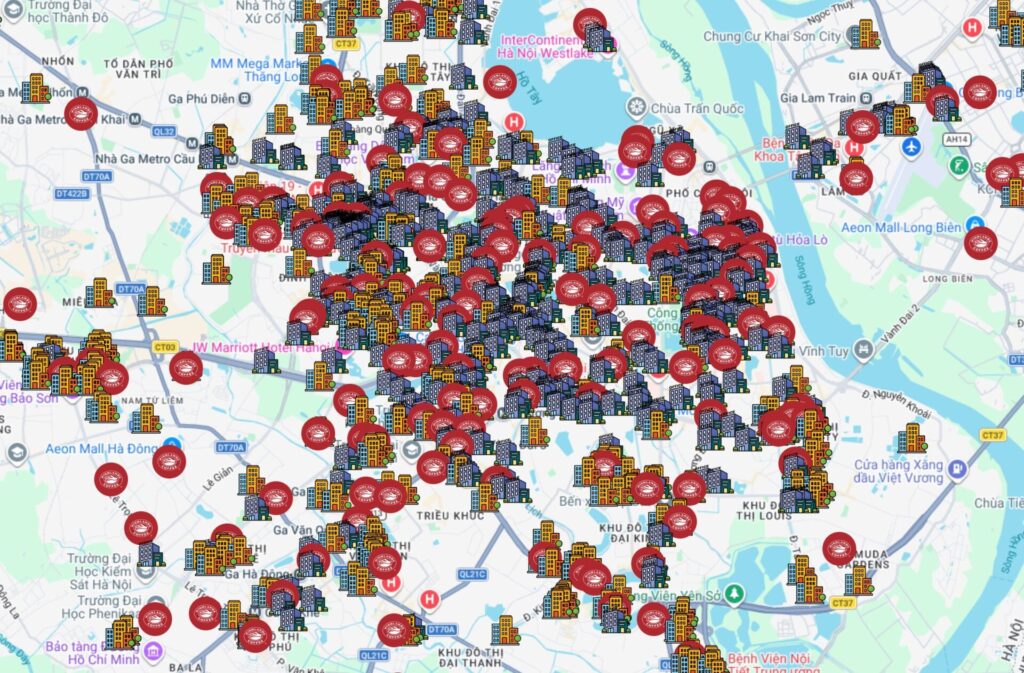
When I overlay Highlands Coffee data onto a Mapdy office building map, what you can clearly see in the images below becomes very clear. In District 1, Ho Chi Minh City, the red dots of Highlands Coffee almost completely surround the clusters of offices along the Dong Khoi, Le Thanh Ton, and Ham Nghi axes. In Hanoi, the highest density of red dots is in the Hoan Kiem and Ba Dinh areas, which also have the highest concentration of offices in the city. In Da Nang, the chain of Highlands Coffee locations runs along Ham Nghi and the Han River, two main streets with a high concentration of offices and commercial hotels in the city.
The consistent principle I've drawn after looking at the maps of all three cities is: Highlands doesn't choose prime locations; they choose locations situated on the commuter traffic flow. Prime location is a subjective concept. Commuter traffic flow, however, is measurable, and when you overlay these two layers of data, you'll see that Highlands' location selection decisions aren't based on intuition but are very systematic.
Starbucks takes a different approach, selecting the most upscale locations and accepting smaller customer bases. Phuc Long is more flexible in terms of space, able to enter smaller spaces within commercial areas. Katinat is infiltrating street corners that neither has yet occupied, a strategy of a latecomer but one that is accelerating. Highlands chooses a middle ground: large enough to create an experience, numerous enough to cover a wide area, and always located on the daily commuter routes.
The next question I want to ask is: if the criteria for selecting locations are as stated, why is Highlands' approach in Ho Chi Minh City, Hanoi, and Da Nang completely different? And which city is generating the most revenue for them—and not the city many people think it is? The next article will answer that question.
(Map data in the article) Mapdy.vn – Vietnam's chain store data platform.
Image source: Highlands Coffee
P.S.: This is my personal perspective based on data and real-world experience. It's neither entirely right nor entirely wrong, so please read it as a reference. I'd be happy if you could share your opinions so we can all learn together. 
Minh Phan – Choosing the right location
Did you find this article helpful?
Sign up to receive new articles every week on store layout and retail development.