Last weekend, right after finishing my KHS0 class, I received a message from a friend saying that another training provider was using the 4T formula without citing the source. I wasn't upset, but rather happy. Happy because what I had learned from real-world mistakes, from those times I made wrong choices and paid the price with real money, was actually helping more people open businesses with less risk. And I felt even more strongly that my decision a few years ago to sit down and systematize the process of searching for and evaluating locations into a clear framework was the right one, even though at the time I simply wanted to prevent others from making the same mistakes I did.
But I've always thought one thing very clearly: 4T was never created to choose locations for anyone else; it only helps me avoid making the wrong choice.
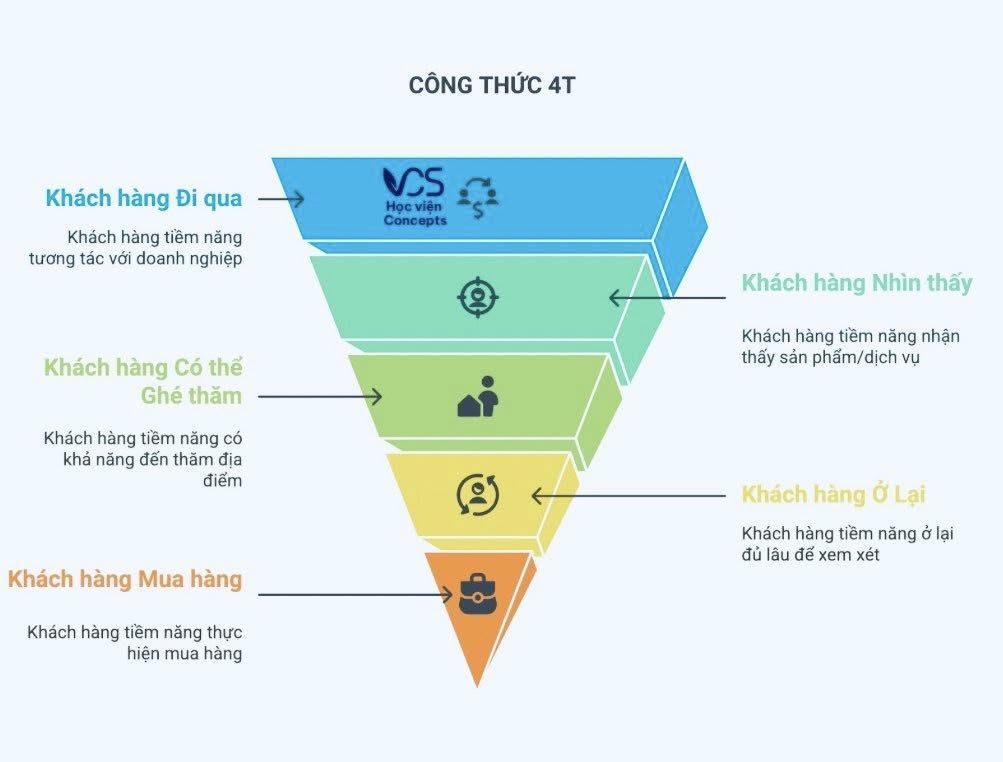
Many people opening a shop for the first time worry: "I'm afraid that sticking too closely to a framework will make it rigid and lose its feel." That worry is very real. But after working on many projects, I realized that a framework doesn't lose the feel; it helps you understand what that feel is based on. In fact, the 4T framework is just a way of looking at the customer journey in real life, just like a funnel from the street gradually into the store. It runs in a continuous stream:
1. Focus – Does this area have enough potential customers? How many people pass by, how many live nearby, and how many actively seek out the product? If the funnel has few customers from the start, even the best work done further down will be very difficult to salvage.
2. Visibility – among those customers, do they see the store? Is the storefront clear? Is the sign obscured? Does the traffic flow long enough for them to notice it? Many places are crowded, but customers… don't see the store at all.
3. Accessibility – how many people can visit? Is it easy to park, is there parking available, and are there any barriers or obstacles blocking the entrance? Many properties look great but fail because customers see them but can't get in.
4. The nature of the space – is it conducive to sales? Is the layout smooth? Do customers stay long enough to make a purchase? What is the actual conversion rate? This is the bottom of the sales funnel.
Looking at it this way, you'll see that the 4T model isn't some profound theory; it simply simulates the customer journey: customer arrives → customer sees → customer enters → customer buys.
Previously, without a clear framework, many decisions were simply summed up in one sentence: "I think this apartment looks good," but that "thinking" often contained a mix of things: a bit of data, a bit of hope, the agent's word, and the pressure of fearing missing out on a desirable property. 4T helps to separate those layers for a clearer view, and interestingly, many people, after analyzing the situation, say to themselves, "I'll pass on this apartment," not because anyone forced them, but because they had already foreseen risks that had been obscured.
I've always thought that opening a store doesn't require being exceptionally skilled from the start; you just need to be level-headed enough to avoid costly mistakes. A framework doesn't guarantee success, but it helps reduce recklessness. And for me, that's already incredibly valuable.
Did you find this article helpful?
Sign up to receive new articles every week on store layout and retail development.