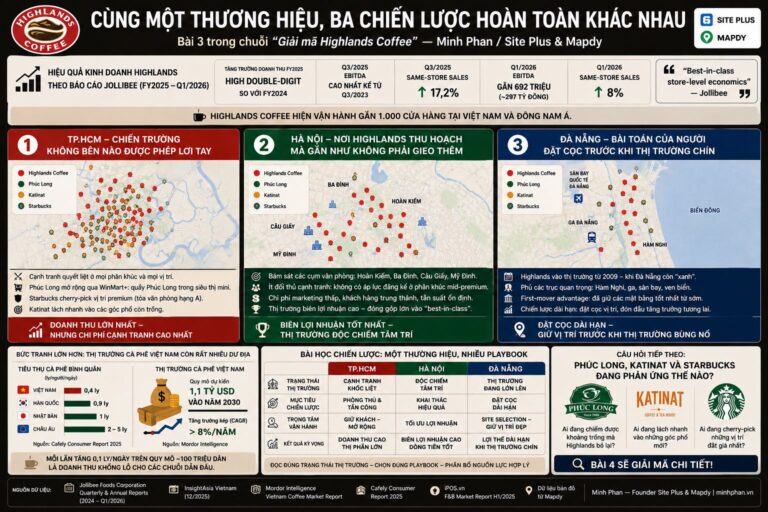
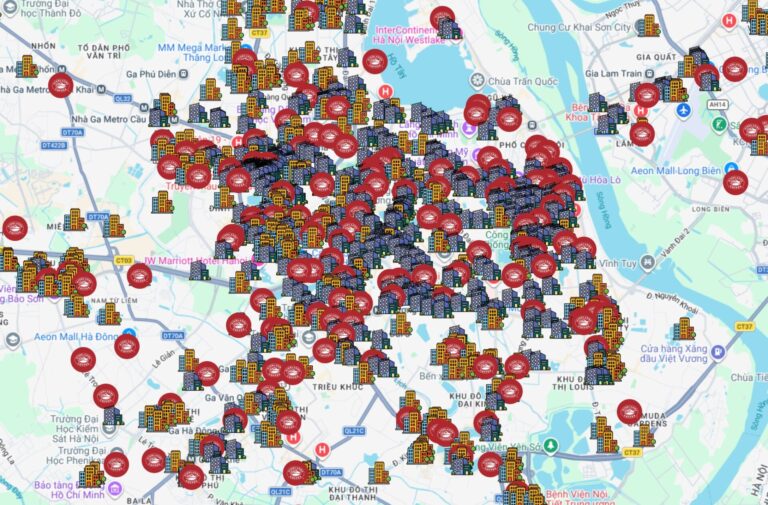
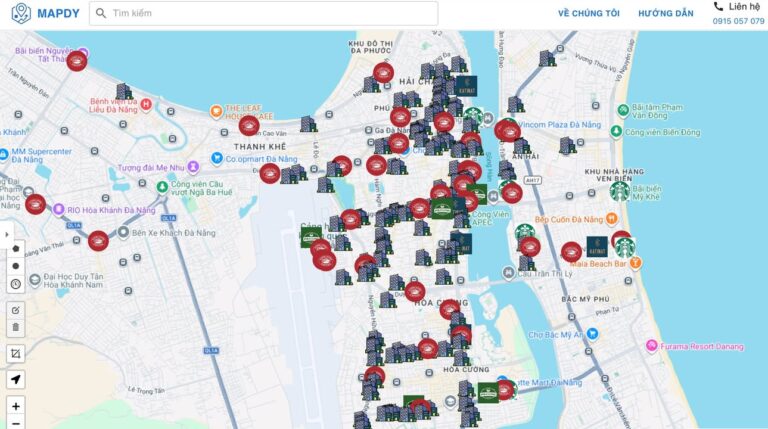
I've done a lot of surveys with clients, and almost eight out of ten people start with the same question: "How many similar restaurants are there around here?" This isn't wrong, but it's too incomplete. And if you only rely on that to make a decision, you're essentially betting your money on an incomplete picture.
The problem lies in the fact that we view competition within a specific industry, while customers make decisions based on "options at that moment." According to several F&B market reports in Vietnam (iPOS 2025), an urban consumer may have 5–10 different food/drink options within a radius of 1–1.5km (≈ 5 minutes by motorbike). This means that when you open a restaurant, you're not just competing with 2–3 similar establishments, but are actually competing within a much larger "menu of choices." And consumer behavior data also shows that over 60% (over 3000 consumers) make impulsive decisions about food and drink, without prior planning; in other words, whoever offers the "more convenience" wins.
Therefore, if you only count direct competitors, you're missing out on a large part of the game.
In practice, I always view competition from three perspectives, and each perspective has data to verify, not just subjective feelings.
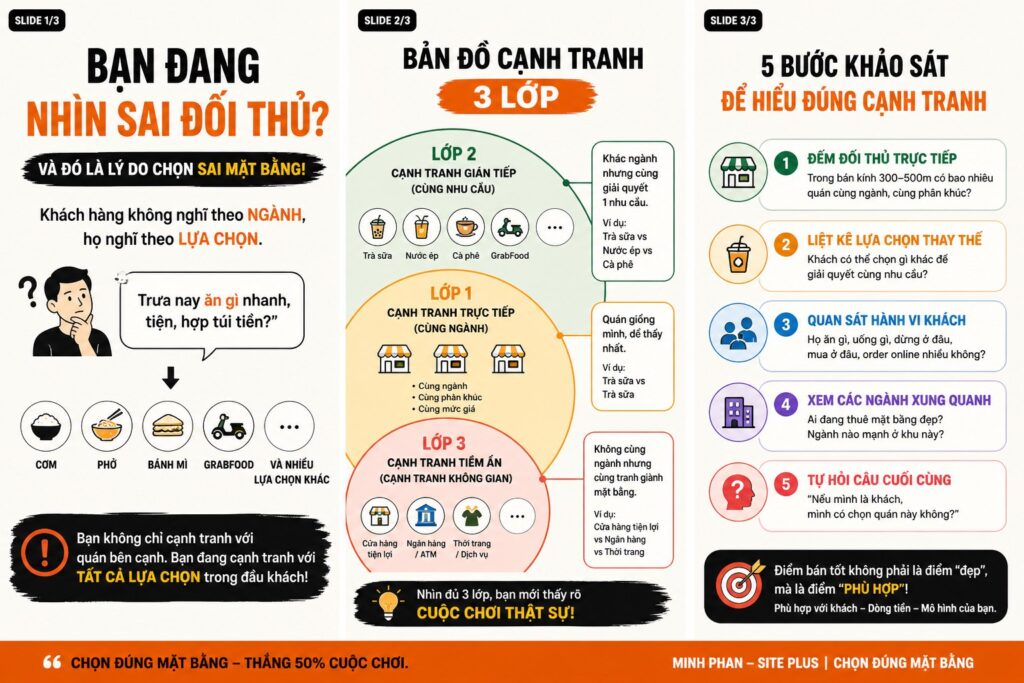
Level 1 is direct competition – within the same industry and segment. This is the most obvious: bubble tea vs. bubble tea, coffee vs. coffee. You can quickly measure this with a few metrics: the number of stores within a 300-500m radius, average price (for example, popular bubble tea is 30k-60k VND), and customer volume during peak hours (count the flow in 15-30 minutes). An area with more than 5-7 shops in the same segment within a 300m radius is almost saturated in terms of brand recognition. But the paradox is: this most obvious competition doesn't determine success or failure, because they all look the same.
Layer 2 is indirect competition – same demand, different industry. This is a layer that most people overlook, but it directly impacts revenue. A very specific example: according to data from food delivery platforms, in Ho Chi Minh City, an average user can see 20–50 food options in a single app launch, within a radius of 2–3km. This means your restaurant is not only competing with neighbors, but also with "online kitchens" several kilometers away. Some important insights to consider:
– The "fast food - under 50k" group: sandwiches, bento boxes, instant pho, snacks.
– The "sit for a long time - experience" group: coffee, milk tea, desserts
– The "convenient - no travel required" group: GrabFood, ShopeeFood
If you open a beverage shop in an area where customers tend to order online more often (you can observe the number of delivery drivers waiting and the frequency of deliveries), then you're likely to lose from the start, even if there are no similar shops nearby. This is why many locations with "no direct competitors" still struggle – because they're losing at the second stage.
Layer 3 is the hidden competition – spatial competition. This is an extremely important layer when choosing a location, but few people pay attention to it. A prime location on a main street isn't just for F&B businesses. According to Vietnamese retail market data, industries that can afford high rental prices are typically: banks, convenience stores, bubble tea shops, pharmaceuticals, and fast fashion. For example, WinMart+, Bach Hoa Xanh, and Circle K currently have thousands of stores (WinMart+ has over 4,500, BHX over 2,700). These chains can accept higher rental prices than smaller F&B businesses because they optimize their operations for chain success. This means that when you rent a space, you're not just competing with restaurants, but with businesses that have stronger financial resources.
From this third stage, two very clear consequences will arise: firstly, rental prices will be pushed up beyond the model's capacity to bear (for example, a space costing 30-50 million VND/month but your expected revenue can only handle 20-25 million VND/month); secondly, you might find a location that is "not meant for you" (for example, a location suitable for quick meals but you open a restaurant with long seating). Many people confuse "beautiful" and "suitable" at this point.
To give you a better understanding, I'll quickly summarize how to read these three layers using a practical checklist:
– Level 1 (direct): How many shops in the same industry are there within a 300-500m radius? What is the average price? How crowded are they during peak hours?
– Layer 2 (indirect): What are customers eating/drinking outside of your industry? How many options are under 50k? Is the online ordering rate high?
– Layer 3 (potential): Which industries are occupying prime locations? Which industries are driving rental prices in this area? Does our model align with that logic?
When conducting market research, I often add a crucial step: I stand there for 15–30 minutes and simply observe. I count the number of people stopping, the number of people passing by, the number of cars that can pull over, and the number of delivery drivers who appear. These numbers, though simple, clearly reflect the flow of money. For example, a location with 200–300 cars in 15 minutes but no designated stopping point is almost meaningless for an F&B business. Conversely, a location with only 100–150 cars but with parking and turning space could be more effective.
My approach isn't about "helping you choose a location," but about helping you see the game correctly. Because once you see it wrong, all subsequent analysis will be wrong as well. Instead of asking "how many competitors are there?", change the question to: "how many options do customers have here, and am I the best option?" When you answer this question with data (not just feelings), the decision will be much clearer.
To conclude with a very important point: choosing the wrong location isn't due to bad luck, but to a lack of perspective. When you only look at direct competitors, you're overlooking a large part of the market. When you look at all three layers – direct, indirect, and potential – you'll see clearly: a good sales location isn't necessarily a "beautiful" location, but one that fits customer behavior, the cash flow of the area, and your own business model. And that "fit" doesn't come from feeling; it comes from correctly reading the competition from the start.
Minh Phan – Site Plus | Choosing the right location.
Did you find this article helpful?
Sign up to receive new articles every week on store layout and retail development.