If you are running or planning to open a fast-food business – such as takeaway coffee, bubble tea, sandwiches, office lunch sets, or meals under 100,000 VND – there is one customer group you cannot ignore: office workers.
Because the fast-moving consumer (FMCG) model relies on three very clear things: repeated daily purchases, quick decisions, and short travel distances. Office workers go to work 5-6 days a week. They need coffee in the morning, a quick lunch, and a drink in the afternoon. They don't have time to travel far or think too much. They choose what's near, fast, and convenient.
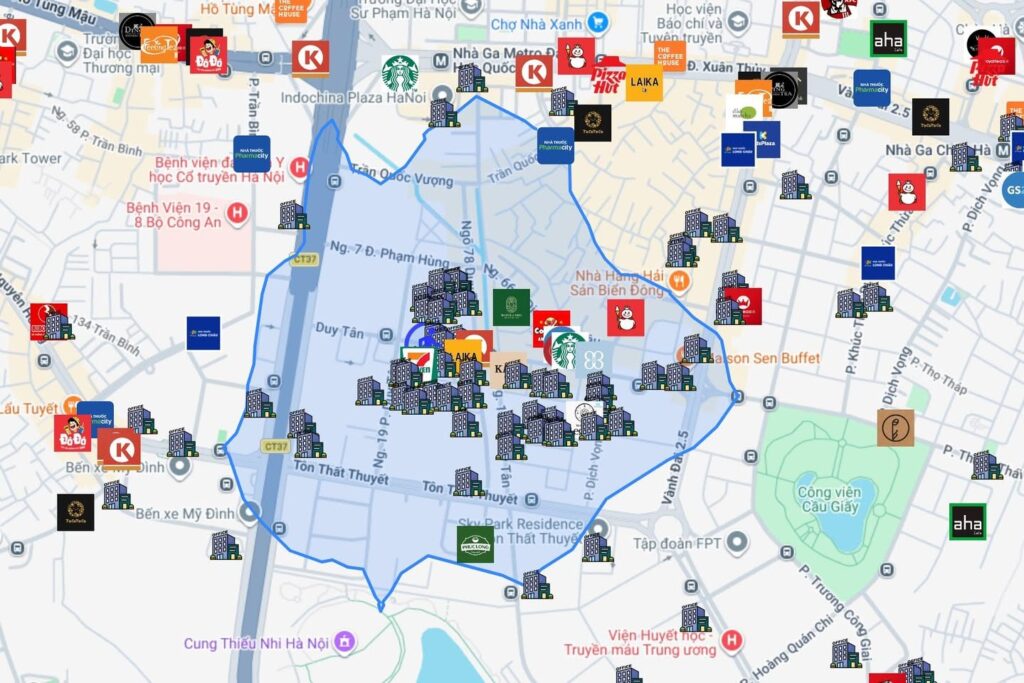
This morning, I opened the map and zoomed in on the Duy Tan – Tran Thai Tong – Ton That Thuyet area. I plotted a 10-minute walking radius around the office core. When I turned on the data layer, the picture became very clear: an area of approximately 75.87 hectares, with a permanent population of just over 8,000 people in about 1,868 buildings. However, the number of office workers operating during the day reaches 75,708 people. This means that during the day, the actual number of people in the area is almost 10 times higher than the resident population. I compiled this figure from data from the General Statistics Office (2019 Population Census and estimates for 2023–2024) combined with data on office buildings and labor force by area.
Looking at the map, it becomes clear: this isn't just an eastern district, but a concentrated consumer cluster. At 11:30 a.m., crowds pour out from dozens of buildings. If your store is within a 300-500m radius in the right direction of traffic, you're practically touching the money flow. If it's off-axis or on the wrong side of the road, you could lose 30-50% of your revenue without understanding why.
According to NielsenIQ, over 60% office workers in major cities eat out at least 3–5 times a week. Euromonitor's Vietnam Foodservice report also shows that the 22–40 age group in urban areas is the main consumer force for the coffee and fast-food segment, with a high priority on convenience and speed. Simply put: they buy frequently and buy nearby.
What I learned from looking at the map wasn't "there are a lot of people here," but "the right people I need are concentrated here." When opening a store, you shouldn't look at the traffic, but at the flow of people going to work. You shouldn't ask "is it crowded?", but "is this the right profile?".
I'm building a map data layer so that anyone opening a store can see this picture: the population density, the number of office workers, their travel routes, and the actual walking radius. Because choosing the right location isn't about luck. It's about understanding the data and understanding customer behavior.
Minh Phan – Choosing the right location
Did you find this article helpful?
Sign up to receive new articles every week on store layout and retail development.